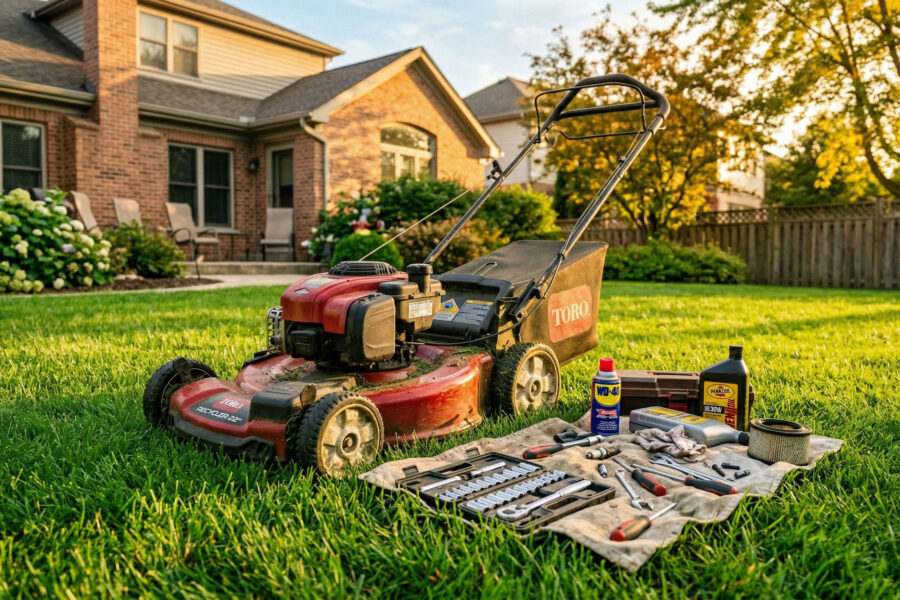
Spring is here, the grass is growing, and you just pulled your lawn mower out of the garage — only to find it won’t start. You’re yanking the pull cord over and over, but nothing happens. Maybe it sputters for a second and dies, or maybe it doesn’t even try.
Don’t worry. This is one of the most common problems homeowners face every spring, and in most cases, you can fix it yourself in under an hour without any special tools. Below, we’ll walk through exactly why your mower won’t start after sitting all winter and how to get it running again — step by step.
Quick Fix Summary
If your lawn mower won’t start after winter storage, try these fixes in order:
- Drain old gas and refill with fresh fuel
- Check and replace the spark plug
- Clean or replace the air filter
- Clean the carburetor (especially the bowl and jets)
- Prime the engine properly (push primer bulb 3–5 times)
- Check the oil level and condition
- Inspect the fuel line and fuel filter for blockages
- Charge or replace the battery (riding mowers)
Most mowers that won’t start after winter just need fresh gas and a new spark plug — a $10 fix that takes 15 minutes.
Why Won’t My Lawn Mower Start After Sitting All Winter?
Here’s the short answer: gasoline goes bad. When fuel sits in your mower’s tank and carburetor for 3–6 months over winter, the lighter compounds in the gasoline evaporate. What’s left behind is a thick, sticky residue that clogs the tiny passages inside the carburetor. This is the number-one reason mowers refuse to start in spring.
But stale gas isn’t the only culprit. Moisture can build up inside the engine, spark plugs can corrode, oil can degrade, and critters can even build nests in your air filter housing. Let’s go through each problem and its fix.
1. Drain the Old Gas and Add Fresh Fuel
Why it happens: Gasoline starts degrading in as little as 30 days. After 3–6 months of winter storage, the ethanol in modern fuel blends absorbs moisture from the air, causing phase separation — where water settles to the bottom of the tank. This watered-down, gummy fuel simply can’t ignite properly.
How to fix it:
- Disconnect the spark plug wire first (safety first — you don’t want the engine firing while you’re working on it).
- Place a container under the fuel tank and drain the old gas completely. Most mowers have a fuel line you can disconnect near the carburetor, or you can use a siphon pump.
- Look at the old fuel. If it’s darker than normal, smells sour or varnish-like, or looks cloudy, it’s definitely bad.
- Fill the tank with fresh, high-quality gasoline. Use regular unleaded (87 octane) unless your owner’s manual says otherwise.
- If you can find ethanol-free gas (often labeled “recreational fuel” or “REC-90” at gas stations), that’s even better — it’s gentler on small engines.
Pro tip: Going forward, always add a fuel stabilizer (like STA-BIL or Sea Foam) to your gas tank before storing your mower for winter. It costs about $8 a bottle and prevents this entire problem.
2. Check and Replace the Spark Plug
Why it happens: The spark plug is what ignites the fuel-air mixture inside the engine. After months of sitting — especially in a damp garage or shed — the spark plug electrode can corrode, foul with carbon deposits, or simply wear out. A weak or missing spark means no combustion and no start.
How to fix it:
- Locate the spark plug on the side or top of the engine (it has a thick rubber boot/wire attached to it).
- Pull the boot off and use a spark plug socket wrench (usually 13/16” or 3/4”) to unscrew the plug.
- Examine the tip. You’re looking for: heavy black carbon buildup, rust or corrosion on the electrode, a cracked porcelain insulator, or a gap that’s too wide.
- If it looks dirty but intact, clean the electrode with a wire brush and re-gap it to the specification in your owner’s manual (typically 0.030 inches for most residential mowers).
- Better yet, just replace it. A new spark plug costs $3–$5 at any hardware store and is the single best bang-for-your-buck maintenance item. Bring the old one to the store to match the size.
- Screw in the new plug hand-tight, then snug it 1/4 turn with the wrench. Reattach the spark plug wire.
Pro tip: Replace your spark plug every season. It’s cheap insurance for easy starts.
3. Clean or Replace the Air Filter
Why it happens: Your mower’s air filter prevents dirt, grass clippings, and debris from entering the engine. Over winter, the filter can collect moisture, become home to insects, or simply be so clogged from last season that the engine can’t breathe. Without enough airflow, the engine won’t start — or it’ll start and immediately stall.
How to fix it:
- Locate the air filter housing (usually a rectangular or round plastic cover on the side of the engine, held on by a screw or clip).
- Remove the cover and pull out the filter.
- Paper filter: Hold it up to a light. If you can’t see light through it, it’s clogged. Replace it — paper filters can’t be effectively cleaned. A replacement costs $5–$10.
- Foam filter: Wash it in warm soapy water, rinse thoroughly, squeeze out excess water, and let it dry completely. Then apply a light coating of clean engine oil and squeeze out the excess before reinstalling.
- Check inside the housing for mouse nests, debris, or standing water. Clean it out completely before reinstalling the filter.
4. Clean the Carburetor
Why it happens: The carburetor mixes fuel and air in the precise ratio the engine needs to run. When stale fuel evaporates inside the carburetor over winter, it leaves behind a varnish-like residue that blocks the tiny jets and passages. This is the most common reason a mower cranks but won’t actually fire up or stay running.
How to fix it (easy method — no disassembly):
- Remove the air filter (see step 3 above).
- Spray carburetor cleaner directly into the carburetor throat (the opening where the air filter was).
- If your mower has a primer bulb, press it 3–5 times to push fresh fuel through the carburetor.
- Try to start the mower. Sometimes this alone dislodges the gunk.
How to fix it (thorough method):
- Locate the carburetor bowl — the cup-shaped piece at the bottom of the carburetor, usually held on by a single bolt.
- Place a rag underneath and remove the bowl bolt. Fuel and residue will drip out.
- Check the bolt itself — many mowers use a bolt with tiny holes in it that serve as a jet. If these holes are clogged, push a thin wire or needle through them.
- Clean the bowl with carburetor cleaner and a rag. Remove any crusty residue.
- Spray carburetor cleaner up into the carburetor body, through all visible holes and passages.
- Reassemble, making sure the gasket is seated properly. The gasket prevents air leaks that would throw off the fuel-air mixture.
When to call a pro: If the carburetor residue is thick and hardened, a full removal and overnight soak in carburetor solvent may be needed. If you’re not comfortable removing the carburetor, a small engine repair shop will typically clean it for $40–$75.
5. Prime the Engine Properly
Why it happens: After months of storage, the carburetor and fuel lines are dry. The engine needs fuel physically pushed into the carburetor before it can start. Many people either skip priming or don’t do it enough.
How to fix it:
- Find the primer bulb — a small, soft rubber button usually on the side of the engine or on the air filter housing.
- Press it slowly 3–5 times. You should feel some resistance as it pushes fuel from the tank into the carburetor. If it feels completely loose with no resistance, you may have a cracked primer bulb or a fuel delivery issue (see step 7).
- Try to start the mower within 10 seconds of priming.
- No primer bulb? Some mowers use a choke lever or automatic choke instead. Make sure the choke is set to “full choke” or the “start” position for cold starts. Once the engine fires, gradually move the choke to the “run” position.
6. Check the Oil Level and Condition
Why it happens: Most modern mowers have a low-oil safety shutoff that prevents the engine from starting when the oil level is too low — this protects the engine from seizing. Additionally, oil that sat all winter can become contaminated with moisture, turning milky white or much thicker than normal.
How to fix it:
- Locate the oil dipstick (usually a yellow or orange cap on the engine).
- Remove it, wipe it clean, reinsert fully, and pull it out to check the level.
- Oil should be between the “full” and “add” marks. If it’s low, add the correct type of oil for your mower (check the manual — most use SAE 30 or 10W-30).
- If the oil looks milky white, gritty, or very dark and thick, drain it and refill with fresh oil. Most push mowers take about 15–20 ounces of oil.
- To drain: tip the mower on its side with the carburetor facing UP (this prevents oil from flooding the air filter), or use the drain plug if your mower has one.
Pro tip: Change the oil at the start of every mowing season, even if it looks fine. Fresh oil extends engine life significantly.
7. Inspect the Fuel Line and Fuel Filter
Why it happens: The rubber fuel line that runs from the tank to the carburetor can crack, dry out, or become pinched over winter. If the line is blocked or leaking, fuel never reaches the carburetor no matter how many times you prime or pull.
How to fix it:
- Visually trace the fuel line from the tank to the carburetor. Look for cracks, kinks, dry rot, or disconnections.
- If you see damage, replace the fuel line. It’s inexpensive (a few dollars for a length of fuel line at any hardware store) and easy to swap.
- If your mower has an inline fuel filter (a small, clear or opaque cylinder in the fuel line), inspect it. If it looks discolored or clogged, replace it — they cost $3–$5.
- To test fuel flow: disconnect the fuel line at the carburetor end, hold it over a container, and briefly open the fuel shutoff valve (if your mower has one). You should see a steady flow of fuel. If not, the blockage is in the line, filter, or tank.
8. Charge or Replace the Battery (Riding Mowers)
Why it happens: If you have a riding mower or any mower with an electric start, the battery is a prime suspect after winter. Batteries lose charge over time, and cold temperatures accelerate the discharge. A battery that’s been sitting in a cold garage for 4–5 months may not have enough power to turn the starter motor.
How to fix it:
- Locate the battery (usually under the seat on riding mowers).
- Check the battery terminals for corrosion — white or greenish crusty buildup. Clean with a wire brush and a mixture of baking soda and water.
- Try charging the battery with a trickle charger or battery maintainer for several hours.
- Test the voltage with a multimeter if you have one. A fully charged 12-volt battery should read 12.6 volts or higher. Below 12.0 volts, it likely needs replacement.
- If the battery won’t hold a charge, replace it. Most riding mower batteries cost $30–$60 and are widely available at hardware stores and auto parts stores.
Pro tip: Invest in a battery maintainer ($20–$30) and keep it connected to your mower battery during winter storage. It automatically maintains the optimal charge level without overcharging.
Still Won’t Start? Check These Less Common Issues
If you’ve gone through all eight steps above and your mower still won’t start, here are a few less common culprits:
Safety switches: Most mowers have safety interlock switches. On push mowers, the bail lever (the bar you squeeze against the handle) must be fully engaged. On riding mowers, you may need to be seated, have the blade disengaged, and the parking brake set. A faulty safety switch can prevent starting even when everything else is fine.
Flywheel key: The flywheel key is a small, soft metal piece that aligns the flywheel with the crankshaft. If your mower hit a rock or stump last season, this key may have sheared, throwing off the ignition timing. A replacement key costs under $5, but the repair requires removing the flywheel — this is a good one for a small engine mechanic if you’re not experienced.
Compression problems: If the engine turns over very easily when you pull the cord (less resistance than normal), you may have a compression issue — possibly a worn piston ring or leaky valve. This typically requires professional repair.
How to Prevent This Next Winter
The best fix is prevention. Here’s your end-of-season checklist:
- Add fuel stabilizer to the gas tank and run the mower for 5 minutes to circulate it through the system, OR drain the fuel tank and run the engine until it stalls to empty the carburetor.
- Change the oil so you’re not storing the mower with dirty, acidic oil sitting in the engine.
- Remove and clean or replace the spark plug.
- Clean or replace the air filter.
- Disconnect the battery on riding mowers, or better yet, connect a battery maintainer.
- Store in a dry location — moisture is the enemy of small engines.
Frequently Asked Questions
Can I use last year’s gas if I added fuel stabilizer?
Yes — if you added a fuel stabilizer before storage, the gas should still be usable for up to 12 months. However, if you didn’t add stabilizer, gas older than 30 days is suspect and gas older than 90 days should definitely be drained and replaced.
How much does it cost to get a lawn mower serviced professionally?
A basic spring tune-up (oil change, new spark plug, air filter, blade sharpening) typically costs $50–$100 at a small engine repair shop. A carburetor cleaning adds $40–$75 on top of that. Compared to buying a new mower ($200–$500+), a tune-up is almost always worth it.
My mower starts but dies after a few seconds — what’s wrong?
This almost always points to a fuel delivery problem — most commonly a clogged carburetor. The engine starts on the fuel from priming, but once that’s burned through, the clogged carburetor can’t deliver a steady supply. Clean the carburetor using the steps in section 4 above.
Should I use ethanol-free gas in my lawn mower?
If it’s available and affordable in your area, absolutely. Ethanol-free gas (often labeled “REC-90” or “recreational fuel”) doesn’t absorb moisture the way ethanol-blended fuels do, which means less carburetor buildup and fewer starting problems. It’s especially worthwhile for equipment that sits for weeks between uses.
How often should I replace my lawn mower’s spark plug?
Replace it once per mowing season — ideally at the start of spring when you’re doing your pre-season prep. At $3–$5, it’s the cheapest and most impactful maintenance you can do.
Was this helpful? Share it with a neighbor who’s struggling with their mower this spring!
Have a different lawn mower problem we didn’t cover? Let us know in the comments — we’re building the most helpful fix-it community on the internet, and your question might become our next article.
Related Problems You Might Have: