
By Muhammad Imran | LinkedIn | May 27, 2026
Why NASA’s Moon Base Changes Everything: Rovers, Drones, and a Permanent Lunar Outpost by 2032
On Tuesday, May 26, 2026, NASA held a press conference at its headquarters in Washington, D.C. and unveiled the most detailed blueprint for a Moon Base that any space agency has ever made public. NASA Administrator Jared Isaacman stood before reporters and declared: “The Moon Base will be America’s and humanity’s first outpost on another celestial world.” Two crewed lunar terrain vehicles, a fleet of hopping drones, billion-dollar lander contracts, and a hard timeline stretching to 2032 — this is not a vision document. It is a construction schedule.
Watching this unfold, I kept thinking about how rarely government space programs announce something that genuinely resets the competitive clock. This one did.
Why NASA Is Building a Moon Base — and Why Now
The announcement, catalogued under official press release RELEASE26-046, did not arrive in a vacuum. Artemis 1 sent an uncrewed Orion capsule to lunar orbit and back in late 2022. Artemis 2, which carried four astronauts around the moon, completed successfully last month — April 2026. The program has momentum, and NASA is using it.
The south pole location is not arbitrary. Scientists believe the permanently shadowed crater floors near the lunar south pole harbor large amounts of water ice. Water means drinking water, oxygen, and — crucially — rocket propellant. Whoever establishes a permanent presence there first controls the most strategically valuable real estate off Earth.
Administrator Isaacman made the competitive stakes explicit: “I think it’s important for us to get there first.” China plans a moon base near the south pole as well, with its first crewed lunar landing targeted for 2030. The race is not hypothetical.
See Also
- How Google’s Gemini Spark AI Agent Is Changing Gmail Forever
- Why the Vegas Golden Knights Are the Team to Fear in the 2026 Stanley Cup Finals
- How Wembanyama Made History With a 40-20 Night in NBA Playoff History
How the Moon Base Will Actually Work: Scale, Layout, and Engineering
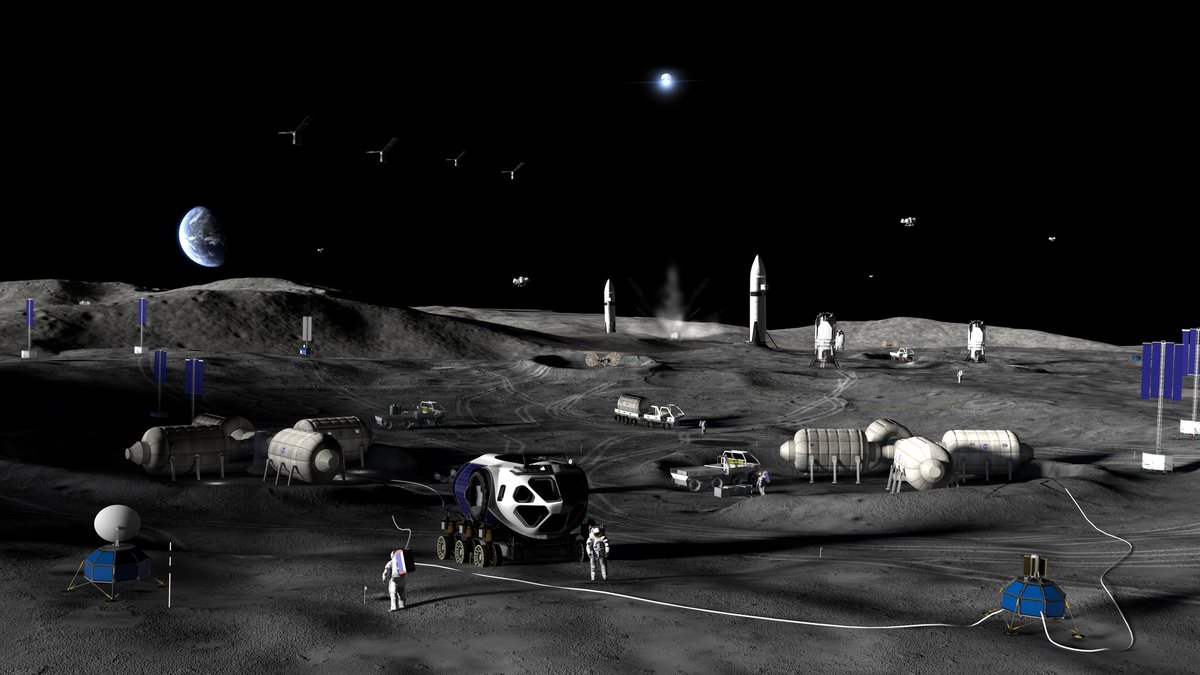
Carlos García-Galán, manager of NASA’s Moon Base program, offered the clearest picture yet of what this outpost will look like on the ground: “We envision the moon base to be hundreds of square miles, with different assets all building up to the objective of permanent lunar presence.”
That scale is not architectural ambition — it is a physical requirement. Chief Architect Nujoud Merancy explained the logic: terrain diversity forces habitats onto hilltops where they can receive consistent sunlight for solar power, while nuclear power systems must sit at least one kilometer away from crew quarters for radiation protection. The footprint of a functional, safe base is necessarily enormous.
Why the Lunar Terrain Vehicles Are Central to the Plan
Two companies won contracts to build crewed lunar terrain vehicles (LTVs) that astronauts will use to explore the surface:
- Astrolab (California-based): $219 million contract for the CLV-1, derived from its FLEX architecture. The vehicle weighs approximately 2,000 pounds and can reach speeds above 6 mph.
- Lunar Outpost (Colorado-based): $220 million contract for the Pegasus rover. It can operate for up to one year on the surface, reach speeds above 9 mph, and function in manual, autonomous, or teleoperated modes.
Both LTVs will be delivered to the lunar surface by Blue Origin’s Blue Moon Mark 1 Endurance lander, under two separate contracts worth $234 million apiece. Blue Origin also holds a broader lander delivery contract valued at $188 million, with an option period worth an additional $280.4 million. NASA’s goal is to have at least one LTV on the lunar surface before Artemis 4, the first crewed south pole landing, scheduled for late 2028.
How MoonFall Drones Will Survey and Secure the Base Perimeter
Firefly Aerospace won a $75 million contract for its MoonFall drone transport spacecraft. MoonFall will deploy a fleet of four drones, with a launch target of 2028. These drones will independently land, gather high-resolution imagery, and survey potential Artemis landing sites. They will also help define the physical boundaries of the base — as NASA described it, the drones will “basically put them at the corners of the areas,” marking the base’s perimeter from the air.

What Happens Next — and Why the 2028 Window Is the Critical One
NASA’s three-phase roadmap is the clearest lunar timeline the agency has published:
- Phase 1 (now through 2029): Gather information, secure reliable access to the lunar surface.
- Phase 2 (2029–2032): Establish initial operating capability.
- Phase 3 (2032 and beyond): Achieve semi-permanent crew presence.
Three uncrewed missions are already on the schedule for this year and next:
- Moon Base I: Blue Origin’s Blue Moon Mark 1 Endurance lander, targeting fall 2026, will land on Shackleton Connecting Ridge carrying Stereo Cameras for Lunar Plume-Surface Studies and a Laser Retroreflective Array.
- Moon Base II: Astrobotic’s Griffin lander paired with Astrolab’s FLIP rover, carrying more than 1,100 pounds of cargo, launching this year.
- Moon Base III: Intuitive Machines’ Nova-C Trinity lander supporting the Lunar Vertex investigation, with payloads from the European Space Agency and the Korea Astronomy and Space Science Institute, also this year.
On the crewed side, Artemis 3 will conduct a docking test in Earth orbit between the Orion capsule and the Blue Moon/Starship system, with a target of mid-2027. That clears the way for Artemis 4’s crewed south pole landing in late 2028. NASA also released the final Request for Proposals for its CLPS 2.0 commercial lunar delivery program on May 15, 2026, with responses due June 30.
Why This Moment Matters Beyond the Space Program
A moon base is not a science project. It is infrastructure — the first permanent foothold humanity will have on another world. Water ice at the south pole means the moon can eventually supply its own propellant, making it a staging ground for deeper space missions rather than a dead end. The contracts NASA awarded span California, Colorado, Texas, and Washington state, representing a deliberate effort to build an industrial base that cannot be easily cancelled by a future administration.
The China dimension matters too. Beijing’s 2030 crewed landing target is not aggressive compared to NASA’s 2028 Artemis 4 timeline, but a race to the south pole — where the water ice is — could reshape geopolitics beyond Earth’s atmosphere. The Outer Space Treaty does not assign territorial sovereignty, which means whoever establishes operational presence first sets the de facto norms for resource access.
Frequently Asked Questions About How NASA’s Moon Base Will Work
Where will NASA’s Moon Base be located?
Near the lunar south pole, which is thought to harbor large amounts of water ice in permanently shadowed crater floors.
How big will the Moon Base be?
NASA envisions the base covering hundreds of square miles. Habitats will sit on hilltops for sunlight access, while nuclear power systems must be placed at least one kilometer away for radiation protection.
When will NASA have a permanent crew on the Moon?
Phase 3, beginning in 2032, targets semi-permanent crew presence. Phase 2 (2029–2032) establishes initial operating capability. Phase 1 (now through 2029) focuses on information gathering and securing reliable access.
What companies did NASA award Moon Base contracts to?
Astrolab ($219 million for the CLV-1 rover), Lunar Outpost ($220 million for the Pegasus rover), Blue Origin (two LTV delivery contracts at $234 million apiece, plus $188 million and a $280.4 million option period for lander services), and Firefly Aerospace ($75 million for MoonFall drone transport).
Is China also building a Moon Base?
Yes. China plans a moon base near the south pole, with its first crewed lunar landing targeted for 2030.
Sources
- NASA.gov — NASA Provides Update on Moon Base Rovers, Landers, Missions (May 26, 2026)
- Space.com — Artemis Moon Base Will Cover Hundreds of Square Miles (May 26, 2026, Mike Wall)
- NPR — NASA Moon Base Plans (May 27, 2026)
- PBS NewsHour — NASA Shares Plans to Construct Moon Base (May 27, 2026)
- NBC News — NASA Announces Moon Missions to Prepare and Build Base (May 27, 2026)
Our Point of View
What separates this announcement from NASA press conferences of the past decade is specificity. Dollar figures, company names, vehicle weights, speeds, mission numbers, and a hard three-phase schedule — this reads like an engineering program, not a political aspiration. The decision to award parallel LTV contracts to two different companies (Astrolab and Lunar Outpost) mirrors NASA’s proven dual-provider strategy and builds in redundancy from day one. The MoonFall drone fleet is the sleeper story: autonomous perimeter mapping is the kind of capability that turns a landing site into an operational base. If the 2028 Artemis 4 landing delivers on schedule, this blueprint will have cleared its hardest test.
Editorial Review & Transparency: This article was reviewed by our editorial desk for accuracy. Muhammad Imran is verified at LinkedIn. Sources are linked inline and listed above. We update articles when new information becomes available. Last reviewed: May 27, 2026.

Related Reading
- Why The Mandalorian and Grogu’s Return to Theaters Is the Star Wars Moment Fans Have Been Waiting For
- Why Your Dishwasher Won’t Drain — and the 15-Minute Fix That Actually Works
- Montreal Canadiens vs. Hurricanes Game 1 ECF — What the First Period Told Us
Disclaimer: This article is for informational purposes only. FixItWhy Media makes no guarantees regarding the accuracy or completeness of information obtained from third-party sources. Always consult official sources for the most current information. © 2026 FixItWhy Media. All rights reserved.