
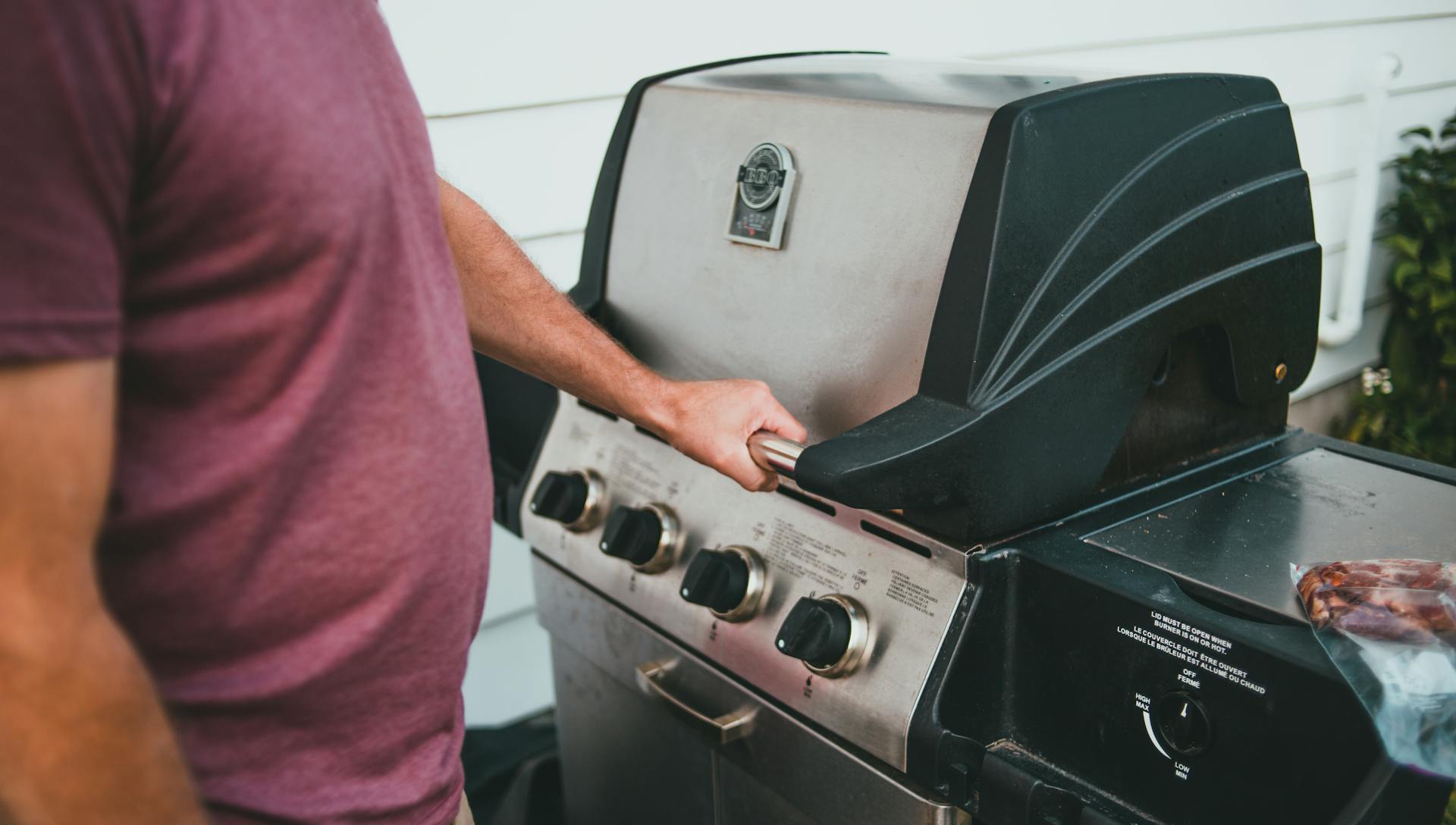
You fire up the grill for the first cookout of June, crank every burner to high, and wait. Five minutes go by. Ten. You lift the lid and the thermometer is stuck at 250°F — barely warm enough to cook a hot dog, let alone sear a steak. The flames look thin and blue-yellow, almost lazy. You shake the tank. It feels heavy. So why is a gas grill not getting hot? Nine times out of ten the problem is not an empty tank, not bad burners, and not a failing regulator. It is the regulator stuck in what the industry calls bypass mode — a built-in safety throttle that chokes gas flow to roughly 10 percent of normal. The fix takes about 20 minutes and costs nothing.
From the Yard: What Actually Happened
Got called over to a neighbor’s cookout last weekend — brand-new four-burner grill, still had the assembly stickers on the side panels. Nobody could figure out why it would not break 300°F. Everyone assumed the tank was bad or nearly empty. I swapped in a full tank from my truck and got the exact same result: thin flames, no heat. Checked the regulator. It had gone into bypass. Reset took four minutes, and within another three the lid thermometer was past 550°F. Dinner saved. The bypass mode trigger is almost always the same thing: someone opened a burner valve before fully opening the tank valve, or cracked the tank valve open too fast. The regulator senses what it interprets as a sudden pressure drop — the kind that happens during a gas leak — and throttles down hard as a precaution. It does exactly what it is designed to do. You just need to teach it that everything is fine.
Tools and Parts You’ll Need
This repair requires no parts and almost no tools. Here is what I bring:
- Liquid dish soap and water in a spray bottle — for a soapy-water leak check after the reset. Non-negotiable safety step. Mix about one tablespoon of dish soap per cup of water.
- Soft bottle brush or venturi brush — a long, flexible brush sold at Home Depot and Lowe’s for clearing venturi tubes.
- Thin wire or pipe cleaner — for clearing individual burner port holes.
- Grill brush or wire brush — to knock carbon off the burner tube surface.
- Flashlight — to see inside venturi tubes for spider webs or debris.
- Optional: venturi and spider guards — small mesh screens that slip over the venturi intake openings to prevent insects from nesting. Cheap and worth installing once you have it apart.
Total cost if you are buying everything: under $15. And if it is just bypass mode, you will not even open a package.
See also: Why Your Window AC Isn’t Cooling (and How to Fix It in 30 Minutes) · Why Your Lawn Mower Dies After It Warms Up · Why Your Water Heater Pilot Light Won’t Stay Lit
Step-by-Step Fix: Regulator Reset and Beyond
- Safety first — shut everything down and work outdoors. Turn off every burner knob on the grill. Then close the tank valve by turning it clockwise until it stops. Do this whole procedure outside, away from any ignition source, open flame, or enclosed space. Propane is heavier than air — it pools and concentrates at ground level. Never try to locate a gas leak with a lit match or lighter. Soapy water only.
- Disconnect the regulator from the tank. Turn the coupling nut counterclockwise (it is reverse-threaded on most regulators — righty loosey here means twist left when you are looking at the valve face). Set the regulator hose aside so the open end is not resting against the tank or ground.
- Open the grill lid all the way. Leave it up for the entire reset process. This lets any propane that may have accumulated in the cook box disperse into open air.
- Open all the burner knobs for one full minute. Turn every burner valve to the high position and leave them there for about 60 seconds. This bleeds any residual pressure out of the hose and the regulator diaphragm, and it signals to the regulator that there is no pressurized leak downstream. After 60 seconds, close all burner knobs completely.
- Reconnect the regulator — hand-tight only. Screw the coupling nut back onto the tank valve by turning it clockwise. Do not use a wrench. Hand-tight is correct; over-tightening can damage the O-ring seat and actually cause a slow leak.
- Open the tank valve slowly and completely. This is the single most important step. Turn the tank valve counterclockwise very slowly — think one full turn over about 10 seconds. Then continue opening it all the way. A fast snap-open is what triggers bypass mode in the first place. Once fully open, wait 30 seconds before touching a burner knob. This gives the regulator diaphragm time to equalize and seat at full-flow position.
- Perform the soapy-water leak check before lighting. Spray or brush your dish-soap solution generously over the regulator connection at the tank valve, along the entire hose, and at every burner valve connection. Watch for bubbles — steady or growing bubbles mean a real leak. Do not light anything until you find and fix the source. According to the National Fire Protection Association (NFPA), gas grill fires and explosions injure thousands of people annually, and connection leaks are among the leading causes. If you cannot stop a leak with a hand-tightened connection, do not use the grill — see the “When to Call a Pro” section below.
- Light in the correct order: tank valve first, then burner. Stand to the side of the grill — never lean over the open lid when lighting. Turn on the burner you want to ignite first. Then press the igniter, or use a long-reach lighter through the side lighting hole if the igniter has failed. According to Weber’s official grill guidance on bypass mode, the correct lighting sequence is always: tank valve fully open first, wait, then turn on a single burner and ignite within a few seconds. Opening multiple burners before lighting is another common bypass trigger.
- Test the heat output. Close the lid and let it preheat on high for 10 minutes. A properly functioning propane grill should reach 500°F to 550°F or more. If you are seeing that range, you are done.

What to Check If It Still Won’t Heat
Reset done, correct lighting sequence followed, and still stuck at 250°F? Work through these in order:
Clogged burner ports. Each small hole along the top edge of a burner tube can get blocked with grease, carbon, and rust. Remove the cooking grates and heat shields, lift out the burner tubes, and look at the port holes along the top. Blocked holes will be discolored or filled with debris. Clear them one by one with a thin wire, a toothpick, or a dedicated port-cleaning tool — never use a drill bit, which enlarges the holes and changes the air/gas ratio. Per Napoleon Grills’ technical guidance on low flame issues, clogged burner ports are the second most common cause of weak heat after bypass mode.
Spider or insect nests in the venturi tubes. The venturi tubes are the metal tubes that connect each burner to its valve. Spiders and mud dauber wasps are famously drawn to the smell of propane and will build nests inside venturi tubes over winter storage. A blocked venturi creates a dangerous back-burn condition — the flame burns inside the tube rather than at the burner ports. Remove the burner tubes, shine a flashlight through each venturi, and run a venturi brush through every tube you cannot see clear through. This is also why venturi and spider guards are worth the $8 investment.
Cracked or aging regulator hose. Propane hoses and regulators should be replaced every five years or sooner if you see cracking, brittleness, or any discoloration in the rubber. A degraded hose can allow micro-leaks that keep triggering bypass mode even after a reset. Replacements are sold as regulator-and-hose assemblies for $15 to $30 at any hardware store — match the BTU rating on your grill’s label.
Cold or frosted tank. Propane is stored as liquid under pressure and vaporizes as it flows out. In cold weather or when you are running multiple burners at high for an extended time, the tank can cool enough to slow vaporization significantly — you may even see frost on the outside. Move the tank out of shade, let it warm to ambient temperature, or switch to a second tank.
OPD valve sticking. Tanks built after 1998 have an Overfill Protection Device valve. Occasionally the OPD float sticks in the closed position and restricts flow even with a full tank. The fix: close the tank valve, disconnect the regulator, wait 30 seconds, reconnect, and try the slow-open reset again. If it sticks repeatedly, the tank’s OPD valve may need service at a propane fill station.
Tank genuinely low. Weigh the tank. Most standard 20 lb tanks weigh about 17 lbs empty. If yours weighs 17 to 18 lbs, it is empty or nearly so. A full 20 lb exchange tank weighs roughly 37 lbs. Alternatively, pour a cup of warm water down the side of the tank — the level where the outside feels cool to the touch is approximately where the liquid propane line is.
When to Call a Pro
Most gas grill repairs are firmly DIY territory. But stop and call a licensed professional for any of these:
- A leak you cannot stop. If soapy water shows bubbles at any fitting and tightening by hand does not stop them, do not use the grill. Turn off the tank valve, move the tank outdoors away from structures, and call your propane supplier or a licensed plumber.
- A damaged regulator, cracked valve body, or punctured hose. These cannot be patched or duct-taped. Replace the assembly or take the tank to a service center.
- Natural gas (not propane) line work. If your grill is connected to a household natural gas line rather than a portable propane tank, any connection repair, regulator swap, or line work must be done by a licensed gas fitter. This is code-required in virtually every jurisdiction and non-negotiable from a safety standpoint.
Frequently Asked Questions
How do I know it is bypass mode and not an empty tank?
If the grill lights at all and holds a weak, low flame consistently, it is almost certainly bypass mode. An empty or near-empty tank will cause the flame to sputter, shrink, and go out as you cook. You can also weigh the tank (see above) or use the warm-water test to check level before assuming bypass.
Will resetting the regulator waste my propane?
Barely. The 60-second bleed step disperses a negligible amount of gas — far less than a single minute of normal cooking. The reset procedure is not wasteful; it is just clearing the pressure differential that caused the bypass lockout.
How often does bypass mode happen?
More often than most grill owners realize, especially at the start of grilling season when someone reconnects a stored tank and opens the valve quickly out of habit. It can also happen mid-cookout if the tank valve is accidentally bumped closed and then reopened fast. Once you know the correct slow-open sequence, bypass triggering becomes rare.
Can a brand-new grill be in bypass mode right out of the box?
Yes. In fact this is one of the most common first-use complaints about new grills. The grill arrives assembled with the regulator connected, and the first time someone hooks up a tank and opens the valve quickly, they trigger bypass before the grill has ever cooked a meal. The fix is identical to what is described above — disconnect, bleed, reconnect slowly.
Sources
- Weber — Why Won’t Your Gas Grill Get Hot? It’s Probably in Bypass Mode (weber.com)
- Napoleon Grills — How to Fix Low Flame, Low Heat on a Gas Grill (napoleon.com)
- National Fire Protection Association — Grilling Safety (nfpa.org)
Our Point of View
Bypass mode is one of those fixes that feels almost too simple once you know it. The same safety mechanism that protects you from a real gas leak is the one that ruins your cookout when you rush the startup sequence. That is a fair trade-off from an engineering standpoint — we would rather a grill fail safe than fail hot. What we would like to see more grill manufacturers do is print the correct startup sequence on a label right on the tank valve, not buried on page 14 of a manual nobody reads. Until that happens, knowing the reset is the difference between a great cookout and a frustrating one. Slow down the tank valve open, and most grill problems solve themselves.
This article was reviewed by our editorial desk for accuracy. John Fix is verified at LinkedIn. Sources are linked inline and listed above. We update articles when new information becomes available. Last reviewed: June 5, 2026.
 John Fix
John Fix is FixItWhy’s hands-on repair specialist. He spends his weekends with a screwdriver in hand and writes step-by-step fixes the way he’d explain them across a workbench — plainly, safely, and without the upsell.