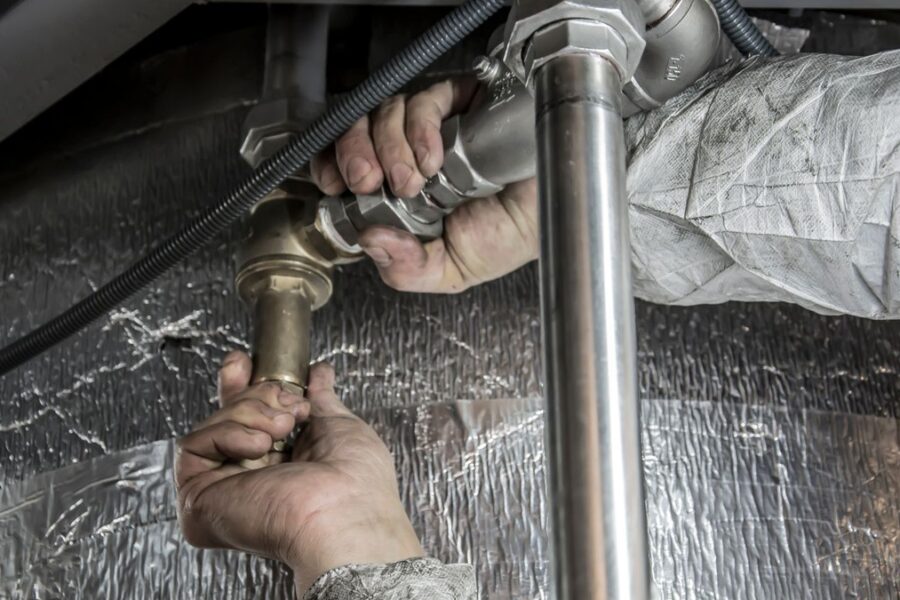
A water heater usually leaks for one of three reasons: a loose or worn drain valve, a temperature & pressure (T&P) relief valve doing its job, or a tank that has rusted through. The first two are quick, inexpensive DIY fixes — a corroded tank means replacement. Before you do anything else, find out where the water is coming from, because the location of the leak tells you almost everything about how serious it is.
First: make it safe and find the source
Water and electricity (or gas) do not mix, so start by shutting things down. For an electric heater, switch off its breaker. For a gas heater, turn the gas control dial to “Pilot.” Then close the cold-water shutoff valve on the pipe entering the top of the tank.
Now dry the whole unit with a towel, lay a few sheets of paper towel under and around it, and check back in 30 to 60 minutes. Where the paper gets wet first points you to the cause:
- Top of the tank – usually the cold/hot water connections.
- Side of the tank – often the T&P relief valve or its discharge pipe.
- Bottom of the tank – typically the drain valve, or, worst case, the tank itself.
1. A loose or faulty drain valve
The drain valve is the spigot near the base, used for flushing the tank. It loosens over time or stops sealing once mineral grit gets into it, and it is the single most common source of a small bottom leak.
The fix: Snug the valve gently with a wrench — a quarter turn is often enough. If it still weeps, attach a garden hose, drain a few gallons to flush out grit, and close it firmly. A cheap brass hose cap threaded onto the outlet will stop a slow drip permanently. Call a pro if the plastic valve body is cracked; replacing it means draining the tank fully.
2. The T&P relief valve is discharging
The temperature & pressure relief valve is a safety device that opens if the tank gets too hot or over-pressurized. Water near this valve, or dripping from the pipe running down beside the tank, usually means the valve is either releasing pressure as designed or has worn out.
The fix: First rule out a real overpressure problem (see cause 4). If pressure is normal and the valve still drips, it has likely failed and should be replaced — an inexpensive part. Call a pro if the valve discharges steaming or very hot water repeatedly; that points to a thermostat or pressure fault that needs immediate attention, since it is a genuine safety issue. If you have lost hot water along with the leak, our guide on why you have no hot water covers the related causes.
3. Loose water-line connections on top
The cold inlet and hot outlet nipples on top of the tank can loosen with years of thermal expansion, or their connectors can corrode, leaving a slow drip that runs down the side and mimics a tank leak.
The fix: Tighten the fittings with two wrenches (one to hold, one to turn) so you do not twist the pipe. If a flexible connector is corroded or split, replace it — they are a few dollars and screw on by hand plus a quarter turn. Call a pro if the threaded nipples themselves are leaking, which requires draining the tank and resealing.
4. Too much water pressure or no expansion tank
When water heats it expands. If household pressure is too high, or there is no expansion tank on a closed plumbing system, that pressure has nowhere to go and forces water out through the T&P valve or weak fittings.
The fix: Test your incoming pressure with a $10 gauge on an outdoor spigot; it should read 40–80 psi. Above that, you need a pressure-reducing valve. On a closed system, a properly sized thermal expansion tank solves repeated T&P dripping. Excess pressure can also show up elsewhere — see our notes on water pressure problems. Call a pro to install a pressure-reducing valve or expansion tank if you are not comfortable with soldered or threaded supply work.
5. Sediment buildup cooking the tank
Minerals settle to the bottom of the tank over the years. That sediment traps heat against the steel, creating hot spots that accelerate corrosion and can eventually crack the lining — a leak that starts at the bottom and gets worse.
The fix: Flush the tank once or twice a year: shut off power/gas and the cold supply, hook a hose to the drain valve, and run it until the water comes out clear. Regular flushing is the single best thing you can do to extend a heater’s life. If the tank is already leaking from corrosion, though, flushing will not save it. A struggling, sediment-choked heater often shows up first as lukewarm water — see why your water heater isn’t getting hot enough.
6. A spent anode rod
The sacrificial anode rod is a metal rod inside the tank designed to corrode instead of the tank walls. Once it is used up — usually after three to five years — the tank itself starts rusting from the inside, which leads to pinhole leaks.
The fix: Check the anode rod every few years and replace it when it is heavily corroded or down to its steel core wire. A fresh rod is cheap insurance that can add years to the tank. Call a pro if the rod is seized in place; breaking it loose without damaging the tank takes the right tools and torque.
7. A cracked or rusted-through tank
If water is seeping from the body of the tank itself — not a valve or fitting — the inner steel has corroded through. There is no patch or sealant that reliably fixes this, and it will only get worse.
The fix: Replace the heater. Most tanks last 8–12 years, so a leaking tank near or past that age is telling you it is time. Shut off the water and power, and plan replacement promptly — a tank that has rusted through can fail suddenly and flood the area. Call a pro for the swap unless you are confident with gas or electrical connections and local code; many areas require a permit. If a leak follows trouble keeping the burner lit, also read why a pilot light won’t stay lit.
Wait — is it actually a leak?
Not every puddle is a failure. A small amount of condensation is normal on a brand-new heater, after a big hot-water draw, or when cold incoming water meets a humid basement. If the dampness disappears once the tank is up to temperature and does not return, you are seeing condensation, not a leak. A true leak keeps producing water.
Frequently asked questions
Is a leaking water heater dangerous?
A slow drip from a valve is mostly a water-damage and efficiency concern. But a leak paired with very hot or steaming discharge, a gas smell, or a bulging tank is a safety issue — shut the unit down and call a professional right away.
Can I keep using the heater while it leaks?
For a minor valve or fitting drip, yes, briefly, while you arrange a fix. If the tank body itself is leaking, turn off the water and power and stop using it; tank leaks worsen and can flood.
How long should a water heater last?
A typical tank heater lasts 8–12 years. Annual flushing and timely anode-rod replacement push it toward the higher end; skipping maintenance and hard water pull it lower.
Should I repair or replace it?
Replace a valve, fitting, or anode rod — those are cheap repairs. Replace the whole unit if the tank is corroded through or the heater is already 10-plus years old, since a new tank avoids throwing good money after bad.
Related fixes
- Why Do I Have No Hot Water? 7 Causes and Fixes
- Why Your Water Heater Isn’t Getting Hot Enough
- Why Your Water Heater Pilot Light Won’t Stay Lit
- Why Your Shower Water Pressure Is Low
- Why Your Faucet Keeps Dripping
Written by John Fix, FixItWhy’s DIY handyman. More fixes from John.