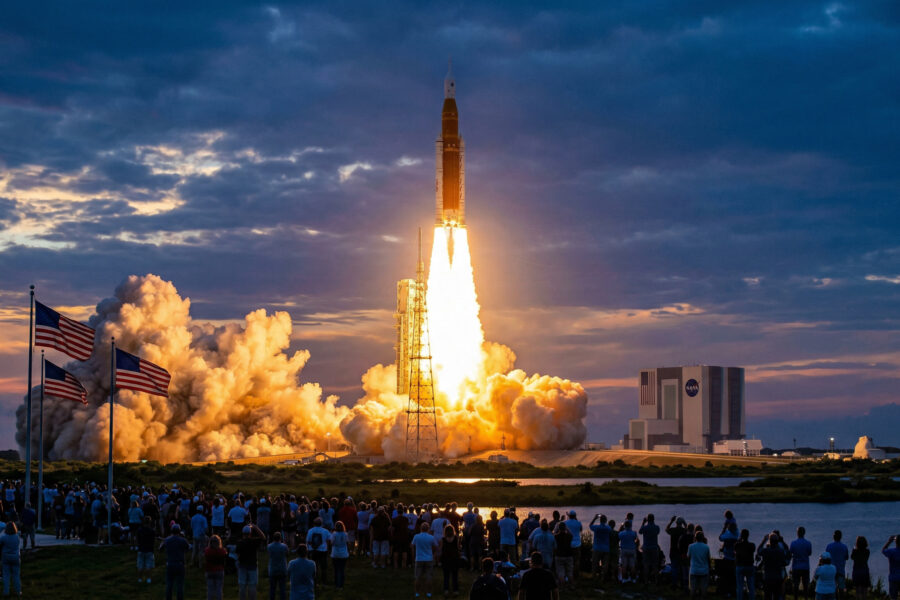
NASA’s Artemis II mission is officially set to launch today, April 1, 2026, marking the first crewed mission to the Moon in over 50 years. If you’ve been following space news, you know this is a monumental moment — and people everywhere are asking the same questions. Let’s break it all down.
What Is Artemis II?
Artemis II is the second mission in NASA’s Artemis program and the first to carry astronauts around the Moon since Apollo 17 in 1972. The crew of four will ride aboard the Orion spacecraft, launched by the massive Space Launch System (SLS) rocket from Kennedy Space Center in Florida. The mission is a 10-day journey that will take the crew on a slingshot trajectory around the Moon and back to Earth.
Why Is This Launch So Important?
This isn’t just a repeat of Apollo. Artemis II is a critical test flight that will verify life support systems, navigation, and communication capabilities for future lunar landing missions. NASA has spent years developing and testing the SLS rocket and Orion capsule, and Artemis II represents the final proving ground before astronauts actually set foot on the lunar surface during Artemis III.
The ultimate goal? Establishing a permanent human presence on the Moon. NASA envisions a lunar base that could serve as a stepping stone for future missions to Mars and deeper into the solar system.
Who Are the Astronauts on Artemis II?
The Artemis II crew includes Commander Reid Wiseman, Pilot Victor Glover, Mission Specialist Christina Koch, and Canadian Space Agency astronaut Jeremy Hansen. Victor Glover will become the first Black astronaut to fly beyond low-Earth orbit, while Christina Koch will be the first woman to do so. Jeremy Hansen will be the first non-American to travel to the Moon.
What Happens During the Mission?
After launch, the crew will orbit Earth before the SLS upper stage fires to send them toward the Moon. They’ll fly behind the far side of the Moon at an altitude of roughly 6,400 miles before heading back to Earth. The entire trip covers approximately 685,000 miles and lasts about 10 days, splashing down in the Pacific Ocean.
How Can You Watch the Artemis II Launch?
NASA is providing full live coverage of the launch on NASA TV and the agency’s website. The launch window opens tonight, and coverage will include commentary, camera views from the launch pad, and mission updates throughout the flight. It’s a must-watch event for anyone interested in space exploration.
What Does This Mean for the Future of Space Travel?
Artemis II sets the stage for Artemis III, which will land the first woman and next man on the Moon. Beyond that, NASA is working with international partners and private companies like SpaceX to build the Gateway space station in lunar orbit, which will serve as a hub for deep space exploration. This launch proves that humanity is serious about returning to the Moon — and eventually reaching Mars.
Stay tuned to FixItWhy for the latest updates on the Artemis II mission and all the trending stories you need to know about.