By John Fix — FixItWhy Staff Writer | April 17, 2026
It happens every April. The temperature crawls into the high 70s, you walk over to the thermostat, nudge it down to 72, and… nothing. No whoosh of cold air. No hum from the condenser outside. Just silence, and a rising sense of dread about what a full HVAC service call is going to cost you in the middle of spring season.
Here is the good news: roughly seven out of ten “my AC won’t turn on” calls turn out to be simple issues you can diagnose — and often fix — yourself in under 30 minutes. Before you pick up the phone, walk through the nine most common causes below. Most spring startup failures come down to one of these, and the fixes are almost always cheaper than a weekend-rate service visit.
1. The Thermostat Is Still Set to “Heat” (or Off)
This sounds obvious, but it is the #1 reason AC units refuse to kick on after winter. If your thermostat has been sitting on “Heat” for five months, switching the mode to “Cool” is step one. Also confirm the fan is set to “Auto” or “On,” the setpoint is at least 3–5 degrees below room temperature, and — for programmable or smart thermostats — that the schedule is not overriding your manual change.
Quick fix: Pop the thermostat cover, replace the batteries (yes, even if the display looks fine), and re-set the mode to Cool. If the screen is completely blank, you have a power issue — see cause #3.
2. A Tripped Breaker at the Electrical Panel
Central AC systems actually have two breakers: one for the indoor air handler/furnace and one for the outdoor condenser. Over winter, power surges from thunderstorms can trip either one without you noticing, because you simply were not using the AC.
Quick fix: Walk to your main electrical panel and look for any breaker that is sitting in the middle position or fully at “Off.” Flip it all the way off, then firmly back to “On.” If it trips again within seconds, stop — you likely have a short, and this one is a call for a licensed electrician or HVAC tech.
3. The Outdoor Disconnect Is Pulled
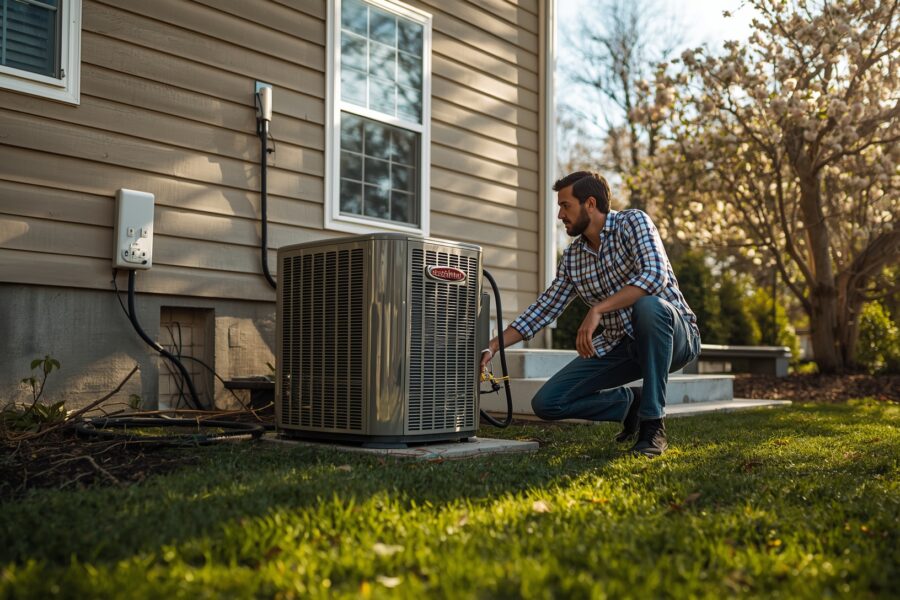
Right next to your outdoor condenser, there is a small gray box mounted on the wall of your house. Inside is a disconnect switch — a pull-out block that completely cuts power to the condenser. Lawn crews, handymen, and your last HVAC tech sometimes leave this pulled, especially after fall service. Open the box and confirm the block is fully seated. Some disconnects look like a small lever instead; flip it to the “On” position.
4. A Clogged Condensate Drain Line Tripped the Float Switch
Modern AC systems have a safety switch on the condensate drain pan. If the drain line is clogged with algae or debris from sitting all winter, water backs up, the float rises, and the switch cuts power to the entire unit to prevent a ceiling leak. No error code — just silence.
Quick fix: Find the white PVC drain pipe near your indoor air handler. Most have a T-shaped cleanout with a removable cap. Pour one cup of distilled white vinegar down it to clear bacterial slime, then use a wet/dry shop vac on the outdoor end of the line to pull the clog free. This one fix resolves an enormous share of “dead” AC calls every spring.
5. A Dirty Air Filter Blocking Airflow
A filter clogged with six months of winter dust can force your blower into a protective shutdown. Some systems simply refuse to run cooling if static pressure is too high.
Quick fix: Replace the filter. A $12 MERV 8 or MERV 11 filter is standard for residential systems; do not jump straight to MERV 13 unless your equipment is sized for it, because overly restrictive filters cause the exact problem you are trying to solve.
6. The Capacitor on the Condenser Has Failed
If you hear the outdoor unit hum briefly but the fan on top will not spin (or the compressor will not start), your start or run capacitor has likely given up over the winter. Capacitors are the most commonly failed part on any central AC, especially after temperature swings.
Quick fix: This is a gray-zone DIY — capacitors store enough charge to hurt you, and the job requires fully powering down the unit, discharging the cap, and matching microfarad ratings exactly. If you are comfortable with a multimeter, a replacement capacitor runs $25–$60 at any supply house. If not, this is the most common — and cheapest — paid service call an HVAC tech will make.
7. The Condenser Coil Is Blanketed in Leaves and Debris
Your outdoor unit sat outside all winter collecting leaves, pollen, cottonwood fluff, and pine needles. When airflow across the coil is choked, high-pressure switches can trip and refuse to restart the compressor.
Quick fix: Shut off power at the disconnect. Use a garden hose (low pressure — never a pressure washer) and spray from the inside of the unit outward to flush debris through the coil fins. Give it 20 minutes to dry, restore power, and try again.
8. The System Is Low on Refrigerant
If the inside is blowing air but it is not cold — or the outdoor unit short-cycles every 2 minutes — you may have a refrigerant leak that developed over winter. Modern systems are sealed, so any “low charge” means there is a leak somewhere that needs to be found and repaired, not just topped off.
Quick fix: None — this one is EPA-regulated and requires a certified HVAC technician with leak-detection equipment. If the tech suggests “just adding a pound,” get a second opinion. Chasing a leak is cheaper than refilling the same system every spring.
9. The Thermostat Wire Came Loose Over Winter
Field mice, settling houses, and vibration from the furnace can all pull low-voltage thermostat wires loose at either the thermostat or the air handler. One loose wire at the “Y” terminal means the cooling call never reaches the condenser.
Quick fix: With power off, pull the thermostat off the wall and confirm every wire is screwed down tight and matches the labeling (R, C, Y, G, W). Repeat at the air handler’s control board. A 10-minute reseat fixes more AC units every spring than most people realize.
Our Take
Before you pay a $150 diagnostic fee this spring, walk through the list above in order — thermostat, breakers, disconnect, float switch, filter, capacitor, coil, refrigerant, wiring. In our experience, the first four items fix about 60% of all “AC won’t start” calls in April and May. If you are still silent after going through those, it is worth the service call — and you will at least know the tech is not charging you to flip a breaker.
Want to stay ahead of the next surprise breakdown? Our guide on why your house smells musty after winter walks through the companion issue most homeowners discover the same week they try to fire up the AC.
Frequently Asked Questions
Why does my AC trip the breaker the moment I turn it on in spring?
Most spring breaker trips point to a failed capacitor, a seized compressor, or a dirty coil causing high amperage draw. Reset the breaker once; if it trips again, stop and call an HVAC tech.
How long after flipping the disconnect should I wait before starting the AC?
Give the system at least 5 minutes after restoring power. Modern thermostats and compressors have built-in delays to protect the compressor from short-cycling.
Is it safe to use a pressure washer on my outdoor AC unit?
No. Pressure washers bend the aluminum coil fins and can drive water into electrical components. A regular garden hose on low pressure is safer and just as effective.
How often should I change my AC filter during cooling season?
Every 30–90 days depending on filter thickness, pets, and household dust. Check it the first of every month; replace when you can no longer see light through it.
Disclaimer: This article is for informational purposes only. Always shut off power at the breaker before working on any HVAC equipment, and defer to a licensed HVAC professional for refrigerant work, sealed-system repairs, or anything inside the outdoor condenser cabinet.
Have your AC troubleshooting story? Drop it in the comments — we read every one and use them to shape our next spring-prep guide.

About John Fix
See also: Why Won’t My Phone Turn On? (8 Causes and How to Fix Each One) · Computer Won’t Turn On? (8 Causes and How to Fix Each One) · Microwave Not Heating — 6 Causes & Fixes
John Fix is a master handyman with over 20 years of experience in home repairs and appliance maintenance. He believes that every problem has a logical solution if you have the right tools and patience.