You turn the key and all you get is a rapid machine-gun clicking sound — click-click-click-click-click — and nothing else. Your stomach drops. Visions of a tow truck, a $600 repair bill, and two days without a car start flashing through your head. Take a breath. In most cases, that clicking is your car’s way of saying, “Hey, the battery is too weak to spin the starter — not that everything is broken.” The good news: you can diagnose and fix this in under 30 minutes with basic tools you probably already own, for $0 to $30 in parts.
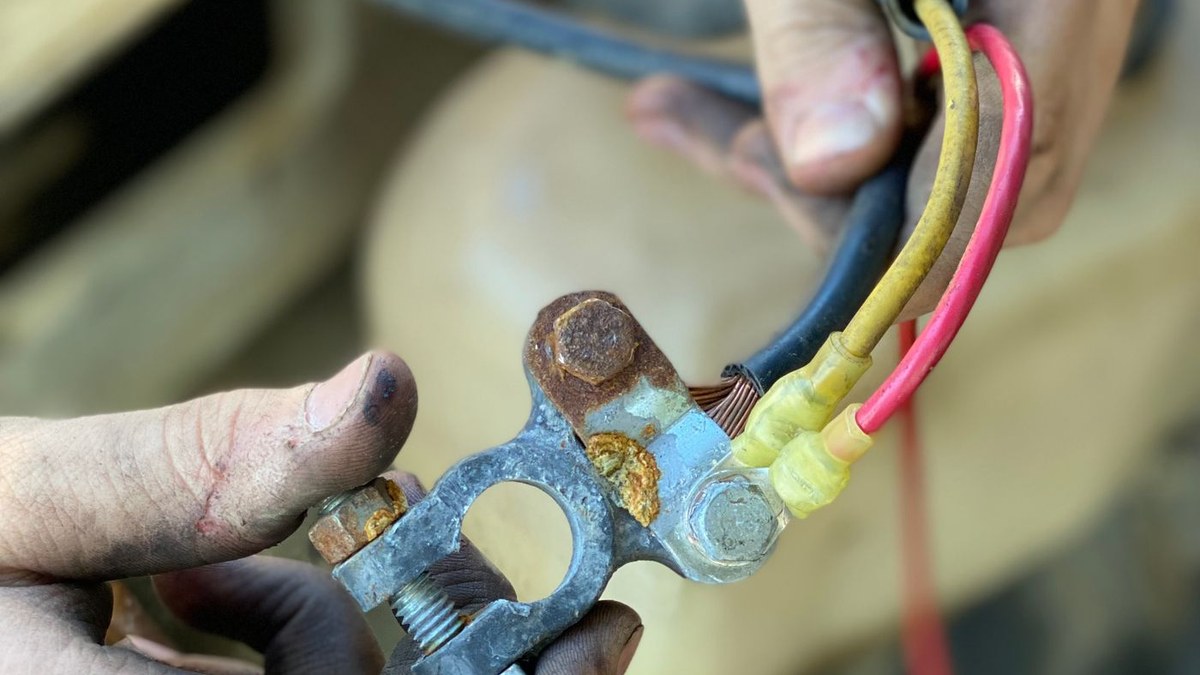
Had this exact situation in my own driveway last Tuesday — went out to run errands and got nothing but a rapid tick-tick-tick from under the hood. My first thought? Starter. Turned out to be a terminal clamp so corroded it looked like a science experiment — white-and-blue crust caked solid around the positive post. Cleaned it off with baking soda and a wire brush in about ten minutes, and the truck fired right up. Not the starter everyone assumes. Not a trip to the shop. A box of baking soda and some elbow grease.
How to Tell What the Clicking Is Actually Telling You
Not all clicks are equal. Here’s how to read the sound before you touch a single tool.
Rapid clicking (click-click-click-click, fast and repeated): This is the classic symptom of a battery that’s too weak to hold the starter solenoid engaged. The solenoid tries to pull in, voltage collapses the instant it draws current, it releases, and the cycle repeats at machine-gun speed. The battery isn’t completely dead — it has some juice — but not enough to crank the engine. This is almost always a battery or terminal issue.
A single loud clunk or click, then silence: This is different. One solid thud usually means the battery voltage is decent enough to engage the solenoid, but the starter motor itself isn’t spinning. That points more toward a faulty starter motor, a bad solenoid, or (occasionally) a seized engine. This scenario is more likely to need a shop visit.
No click at all, no dash lights, nothing: Completely dead. Either the battery is totally discharged, there’s a broken connection somewhere in the circuit (cable, fuse, fusible link), or the battery itself has failed internally. You won’t hear a thing because there’s not enough power to trigger even the solenoid.
Tools and Parts You’ll Need
- Digital multimeter — any budget unit from Home Depot, Lowe’s, or Amazon (Klein MM300, AstroAI AM33D, or similar; under $15–$20)
- Socket or wrench set with 8mm, 10mm, and 13mm sockets — most battery terminal clamps use one of those three sizes
- Wire brush or battery terminal cleaner tool — the inexpensive circular brush tool from AutoZone (OTC 4528 or equivalent, ~$5) works great; an old stiff-bristle toothbrush is a passable backup
- Baking soda and water — a tablespoon of baking soda in a cup of water neutralizes battery acid corrosion on contact
- Safety glasses and work gloves — non-negotiable; battery acid burns eyes and skin
- Jumper cables (at least 10-gauge, 20-foot) — available at AutoZone, O’Reilly, Lowe’s; or a portable lithium jump starter (NOCO Boost Plus GB40 or similar, ~$70–$100 on Amazon) — far safer and faster than finding another car
- Anti-corrosion terminal spray or dielectric grease — Permatex 80370 No-Ox terminal protector spray, or a dab of dielectric grease (both at AutoZone or Home Depot)
- Felt terminal protector washers — the red/green fiber washers that sit under the clamps (~$3 for a pack); they absorb acid vapor and dramatically slow corrosion
- Replacement battery (if needed) — group size varies by vehicle; check your owner’s manual or use the in-store fitment lookup at AutoZone, O’Reilly, or Advance Auto Parts. Expect $80–$200 depending on group size and cold-cranking amp rating
See Also
- Why Your Lawn Mower Dies After It Warms Up
- Why Your Water Heater Pilot Light Won’t Stay Lit
- Why Your Washing Machine Won’t Drain
Step-by-Step: Get Your Car Started Again
- Safety setup first — do this before anything else. Park on a flat surface in Park (or Neutral if it’s a manual) with the parking brake fully engaged. Turn the ignition off. Remove any rings, watches, or metal bracelets — a metal bracelet across battery terminals can arc badly and cause serious burns. Put on your safety glasses and gloves. Batteries vent flammable hydrogen gas, especially when charging or corroded — keep sparks, open flames, and lit cigarettes away from the battery at all times.
- Inspect the battery terminals visually. Pop the hood and look at both the positive (+) and negative (−) terminal clamps. White powdery crust, blue-green fuzz, or a built-up gray mineral layer means corrosion. Even a thin film of corrosion adds enough resistance to prevent the starter from getting full voltage. This alone causes a large percentage of the “clicking and won’t start” calls I hear about.
- Disconnect and clean corroded terminals. Safety: Always loosen and remove the NEGATIVE (−) black cable first. This prevents accidental shorts if your wrench touches grounded metal while working on the positive side. Use your 10mm (or 8mm or 13mm — check yours) to loosen the clamp bolt, wiggle the cable off the post, and tuck it aside. Then remove the positive (+) red cable. Mix a tablespoon of baking soda into a cup of water and pour it over the terminals and cable ends — it will fizz on contact with battery acid. Scrub with the wire brush or terminal cleaner tool until the metal is shiny. Wipe clean with a damp rag, then dry thoroughly.
- Reconnect terminals and tighten — positive first this time. Safety: Reconnect the POSITIVE (+) cable first, then the NEGATIVE (−) last. That is the reverse of the removal order and it matters. Tighten both clamps snugly — they should not rock or spin on the post at all. Slip a felt terminal protector washer under each clamp before reconnecting if you have them. Hit both posts with anti-corrosion spray or a thin coat of dielectric grease.
- Try starting the car. Many times, dirty or loose terminals are the entire problem and the car starts normally the moment you’ve cleaned up the connections. If it starts — great. Let it run for 20–30 minutes to let the alternator top the battery off.
- Test resting battery voltage with the multimeter. If the car still won’t start, set your multimeter to DC Volts (20V range). Touch the red probe to positive (+) and the black probe to negative (−). A healthy battery at rest reads ~12.6V. At 12.4V it’s about 75% charged and may need a charge. Below 12.2V the battery is significantly discharged. Below 12.0V, it’s critically low and may not recover well. Note your reading before jumping.
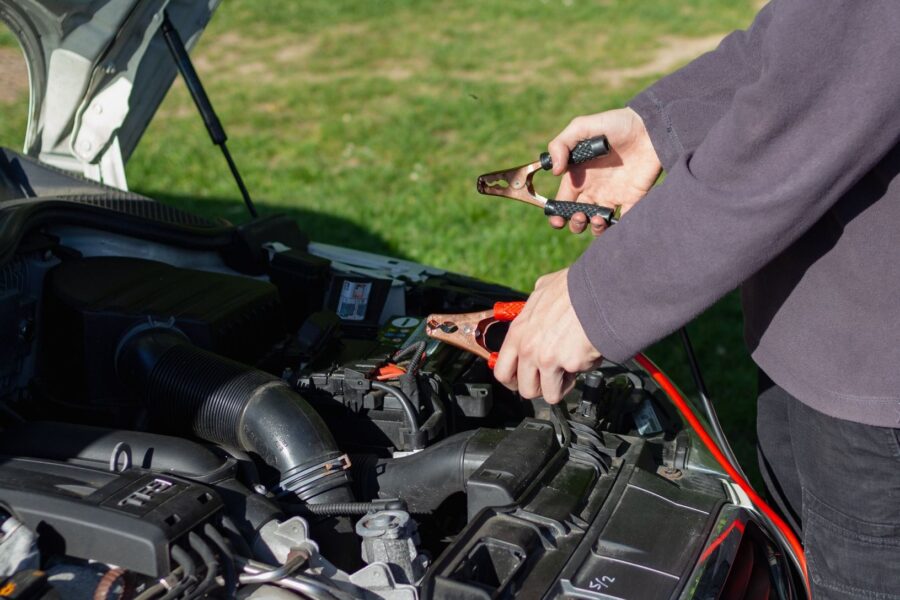
- Jump-start the car. If using jumper cables, you need a second running vehicle. Connect in this order: (1) red cable to the dead battery’s positive (+) post, (2) other red clamp to the donor battery’s positive (+) post, (3) black clamp to the donor battery’s negative (−) post, (4) the final black clamp goes to bare unpainted metal on the dead car’s engine block or chassis — NOT to the dead battery’s negative post. This keeps any spark away from the battery. Start the donor vehicle, wait two minutes, then try starting the dead car. If using a portable lithium jump pack, clamp red to positive (+) and black to negative (−) on your own battery, power on the pack, and crank — no second vehicle needed. Safety: Double-check polarity before connecting. A reversed connection can damage vehicle electronics.
- Get a free battery load test. Once the car is running, drive straight to AutoZone, O’Reilly Auto Parts, or Advance Auto Parts — all three offer free battery load testing in the parking lot. The load tester draws current equivalent to starting the engine and measures how badly the voltage collapses under load. A healthy battery under load should stay above ~9.6V. If it drops below that, the battery cannot reliably start the car even if it shows 12.6V at rest. This test gives you a definitive answer in under five minutes.
- Check the ground strap. If the battery tests fine, locate the main ground strap — a thick black cable that runs from the negative battery terminal to the engine block or body. Tug it. Check both ends for corrosion or loose bolts. A bad ground path starves the starter of return current just as effectively as a dead battery. Clean both connection points with a wire brush and retighten the bolts.
- Replace the battery if it fails the load test. Use the retailer’s fitment lookup (or your owner’s manual) to confirm the correct group size and minimum cold-cranking amp (CCA) rating for your vehicle. Most auto-parts stores will install it for free with purchase. Torque the terminal bolts snugly — finger-tight plus a quarter turn — reinstall the felt washers, spray with terminal protector, and you’re done.

What to Check If It Still Won’t Start
You cleaned the terminals, the battery load-tested good, and it still just clicks. Here’s where to look next.
Corroded or damaged ground cable: The ground strap between the battery negative and the chassis or engine block is one of the most overlooked failure points. A corroded or broken ground creates a high-resistance return path that prevents full current from reaching the starter. Inspect the entire length of the cable for cracked insulation, greenish corrosion at either end, or a loose bolt. Replacement cables cost $15–$30 at any auto-parts store.
Parasitic draw (battery keeps going dead): If you have to jump-start the car more than once a week and the battery consistently tests weak or dead, something is pulling current while the car is parked — a stuck relay, a faulty module that won’t sleep, an aftermarket accessory wired directly to constant power. A shop can diagnose a parasitic draw with a clamp meter in about an hour.
Failing alternator: The alternator charges the battery while the engine runs. A failing alternator can leave you with a dead battery the next morning even after a good charge. Signs include the battery warning light on the dashboard, headlights that dim at idle, or a car that dies shortly after you jump-start it and get moving. An alternator output test (also free at most parts stores) will confirm this.
Bad starter motor or solenoid: If you get a single loud clunk rather than rapid clicking, and the battery is confirmed good, the starter motor or its solenoid is the likely culprit. A bad connection at the starter’s small trigger wire (the “S” terminal) can also cause this. Starter replacement is a legitimate DIY job on many vehicles but requires more disassembly and is beyond a 30-minute fix.
Blown fusible link: Fusible links are thick wire segments in the main power circuit that act as a last-resort fuse. A fusible link can look intact externally but be burned open internally. If you have zero power to anything — no dash lights, no dome light — and the battery is confirmed good, trace the main battery cable and look for a fusible link (a short, slightly thicker section of wire with a rubberized sleeve). Tug gently; a failed one will feel mushy or break apart.
When to Call a Pro
- The battery load-tests good at the parts store but the car still only clicks — this is a starter motor or solenoid issue requiring a licensed mechanic to diagnose and replace properly
- The battery keeps dying repeatedly within days of being replaced or charged — you likely have a parasitic draw or a failing alternator that needs shop-level diagnostic equipment
- The battery or ground cables are severely corroded, cracked, or physically damaged — corroded cables create resistance that no cleaning can fully fix; cable replacement is inexpensive at a shop and eliminates the risk of a partial connection causing intermittent problems
- The battery is visibly swollen, leaking fluid, or has a strong sulfur smell — do not attempt to charge or jump a physically damaged battery; it can rupture or ignite
- Your vehicle is a hybrid or fully electric — never attempt DIY work on the high-voltage orange-cable system in a hybrid or EV. The 12V accessory battery is fair game for the steps above, but the high-voltage traction pack requires certified hybrid technicians with specialized equipment. Treat those orange cables as live and lethal.
Frequently Asked Questions
Can a car click but not start with a good battery?
Yes, though it’s less common. A battery can show a healthy resting voltage of 12.6V but still fail under the high-current demand of cranking — which is why a load test (not just a voltage check) is the definitive answer. Beyond the battery, a single loud click with a good battery typically points to a faulty starter motor, a bad solenoid, or a broken connection at the starter’s trigger wire. Severely corroded or loose terminal clamps can also cause clicking even with a battery that seems fine.
How do I know if it’s the battery or the alternator?
A simple field test: jump-start the car and let it run. If it dies again within a few minutes of driving, the alternator isn’t charging the battery and the car is running solely on whatever charge was left — that’s an alternator problem. If the car runs fine but won’t start the next morning after sitting overnight, the battery is likely failing (or a parasitic draw is draining it). The battery warning light on the dashboard is another strong indicator of alternator trouble, though not all alternator failures trigger that light right away. A free alternator output test at AutoZone or O’Reilly takes five minutes and removes the guesswork.
Is it safe to jump-start my own car?
Yes, if you follow the correct cable order and basic precautions. The biggest risks are reversed polarity (red and black mixed up), which can damage electronics or cause a spark near the battery, and sparking near a battery that’s actively venting hydrogen gas. Stick to the sequence: dead positive → donor positive → donor negative → bare metal ground on the dead car (not the dead battery’s negative post). Remove metal jewelry, wear your safety glasses, keep ignition sources away from the battery, and don’t lean directly over the battery when making that final connection. A portable lithium jump pack like the NOCO Boost GB40 is even safer — no second vehicle, no cable tangle, and the clamps are color-coded and short enough to prevent most mistakes.
How long do car batteries last?
The typical range is three to five years, but real-world life varies significantly. Extreme heat actually degrades batteries faster than cold — internal heat accelerates the chemical breakdown of the plates. Cold weather just makes the damage obvious because a partially degraded battery loses even more capacity when it’s cold. Frequent short trips (less than 15 minutes) that don’t let the alternator fully recharge the battery after each start shorten battery life considerably. So does leaving lights or accessories on, even briefly. If your battery is over four years old and you’re having starting issues, replace it proactively — waiting for a complete failure on a cold morning in a grocery store parking lot is not the plan.
Sources
- AAA — How to Jump-Start a Car
- AutoZone — How to Test a Car Battery
- Interstate Batteries — Car Battery Life Expectancy
Our Point of View
The auto repair industry is perfectly happy for you to believe that a car that clicks and won’t start is a major problem requiring a professional diagnosis. Sometimes it is. But the majority of the time — and we mean the majority — it’s a $0 cleaning job or a $100 battery that any careful adult can handle in a driveway with basic tools. Before you call a tow truck or hand over your keys, spend 15 minutes on the terminal clamps and a free battery test at your nearest parts store. If that doesn’t solve it, you’ve lost nothing and you’ll hand the mechanic a cleaner, better-understood problem. That’s the FixItWhy approach: verify the cheap stuff first, every time.

John Fix
John Fix is a master handyman with 20+ years fixing the everyday breakdowns most people overpay to repair — one logical step at a time.
Disclaimer
The views, opinions, and analysis expressed in this article are solely those of the author and FixItWhy Media. They do not constitute professional advice — whether legal, financial, medical, or otherwise. You are free to agree or disagree with our perspective.
This content is provided for informational and editorial purposes only. We make no representations or warranties of any kind, express or implied, about the completeness, accuracy, reliability, or suitability of the information contained herein. Any action you take based on the information in this article is strictly at your own risk.
If the subject matter involves financial decisions, health concerns, legal matters, home safety, or any regulated activity, we strongly recommend consulting with a qualified licensed professional before taking action. FixItWhy Media and its authors accept no liability for any loss, damage, or injury arising from the use of this information.
© FixItWhy Media. All rights reserved.