
It is 95 degrees outside, the air handler is humming, air is moving through the vents — and your house just will not cool down. An AC running but not cooling is one of the most common summer service calls there is, and the good news is that most of the time the cause is something you can fix yourself in under 30 minutes with no special tools. Before you pay for a service visit, work through the checks below in order.
I ran into this exact problem on a callout last Tuesday. Homeowner swore the compressor was dead and was bracing for a $4,000 bill. Turned out to be a filter so clogged it had iced the evaporator coil solid — a $12 fix once we thawed it out. That is the pattern with cooling complaints: the dramatic-sounding symptom almost always traces back to something boring and cheap. So we start cheap and simple, and only escalate if we have to.
Tools & Parts You’ll Need
Nothing exotic here. Most of this is already in the house or a quick run to the hardware store:
- New air filter — match the size printed on the edge of your old one (common sizes 16x25x1, 20x25x1). Around $8–$20 at Home Depot or Lowe’s.
- Garden hose with a spray nozzle for rinsing the outdoor condenser.
- Fin comb (optional, ~$8) to straighten bent condenser fins.
- Soft brush or shop vac for loose debris.
- Screwdriver / nut driver to open the condenser grille if you clean the coil deeply.
- A flashlight and a wet/dry vac for the condensate drain line.
Power tools and refrigerant gauges are not on this list on purpose. If a fix needs those, it is a job for a licensed pro — more on that below.

See also: If the air itself never gets cold, compare notes with why a car’s AC stops blowing cold, our walkthrough on a refrigerator that runs but won’t cool, and the ceiling-fan fix for squeezing more comfort out of the air you already have.
Step-by-Step Fix
Work these in order. Stop as soon as the house starts cooling again — you have found your culprit.
- Check the thermostat first. Make sure it is set to COOL and the fan is on AUTO, not ON. On ON, the blower runs nonstop and pushes uncooled air between cycles, which feels exactly like “running but not cooling.” Drop the setpoint 3–4 degrees and listen for the outdoor unit to kick on. Swap the batteries while you are there.
- Replace the air filter. A filter caked with dust chokes airflow across the evaporator coil. Pull the old one and hold it to the light — if you can’t see through it, it is done. Slide the new one in with the airflow arrow pointing toward the furnace/air handler. This single step fixes a huge share of “not cooling” calls.
- Open the supply and return vents. Walk the house. Every supply register should be open and unblocked by furniture, rugs, or boxes. Closing too many vents starves the system and can freeze the coil.
- Clear the outdoor condenser. Go outside to the big metal unit. Shut off power at the disconnect box on the wall beside it (or the breaker) before touching it. Pull weeds, leaves, and grass clippings away from all sides — you want at least 2 feet of clearance. Gently rinse the fins from the inside out with the hose (never a pressure washer — it bends the fins). Let it dry, restore power.
- Check for a frozen evaporator coil. If you see ice on the copper lines or the indoor coil, the system has been starved for airflow or is low on refrigerant. Turn the AC OFF at the thermostat but leave the fan ON for 1–3 hours to thaw it. Once fully thawed and dry, restart in COOL. If it ices up again, that points to refrigerant — a pro call.
- Clear the condensate drain. A clogged drain can trip a safety float switch and stop cooling. Find the PVC drain line near the indoor unit and use a wet/dry vac on the outdoor end to pull the clog, or flush with a cup of distilled vinegar.
- Reset a tripped breaker. If the outdoor unit is dead silent, check the breaker panel and the outdoor disconnect. Flip a tripped breaker fully OFF, then ON. If it trips again immediately, stop — that is an electrical fault for a pro.
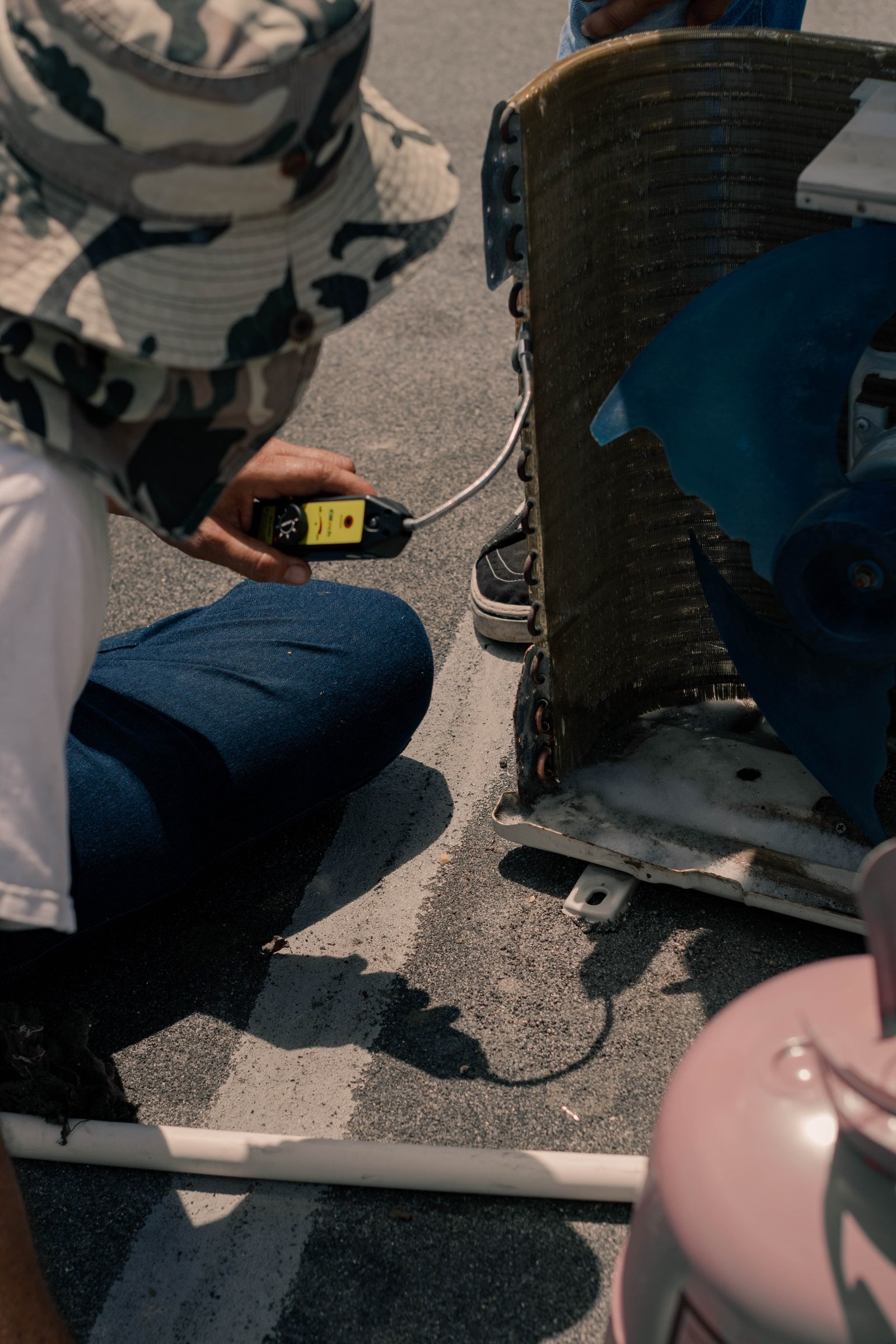
What to Check If It Still Won’t Cool
Worked through all seven and the house is still warm? A few second-order gotchas catch people:
- Dirty coil you can’t see. The evaporator coil inside the air handler can be filthy even with a fresh filter. It usually needs a panel removed and is easy to damage — worth a pro.
- Low refrigerant / leak. If the system cools weakly, ices repeatedly, or you hear hissing, it is likely low on refrigerant. By law in the U.S., handling refrigerant requires EPA Section 608 certification — this is not a DIY job.
- Failing capacitor or compressor. A humming outdoor unit with a fan that won’t spin often means a dead run capacitor. It is a cheap part but sits next to high-voltage terminals that can hold a lethal charge — leave it to a tech.
- Undersized or leaky ductwork. If only some rooms stay hot, you may have duct leaks or a system too small for the space.
When to Call a Pro
Stop and call a licensed HVAC technician the moment a fix involves refrigerant, the sealed system, the compressor, the capacitor, or any repeated breaker trip. Those carry real risk — high voltage, pressurized refrigerant, and federal handling rules — and a wrong move turns a cheap repair into an expensive one or a safety hazard. Cleaning, filters, vents, drains, and thawing a coil are fair game for a homeowner. Anything behind a sealed panel or wired to high voltage is not.
Frequently Asked Questions
Why is my AC running but not cooling the house?
Most often a dirty air filter, a thermostat set to fan-ON, a blocked outdoor condenser, or a frozen evaporator coil. Work those four first — they cover the majority of cases and cost almost nothing.
How long should I leave my AC off to thaw a frozen coil?
Turn cooling off but leave the fan running for 1 to 3 hours until all visible ice is gone and the coil is dry. Large ice buildups can take longer. Never chip the ice off — you’ll puncture the coil.
Why is my AC blowing warm air but the outdoor unit is running?
If air moves but never cools, suspect low refrigerant, a frozen coil, or a thermostat in fan mode. If the outdoor fan spins but the unit just hums and doesn’t cool, it is often a failed capacitor — a pro repair.
Can a dirty filter really stop my AC from cooling?
Yes. A clogged filter starves airflow across the evaporator coil, which drops efficiency and can freeze the coil solid. It is the single most common cause we see, and the cheapest to fix.
Is it safe to spray water on my outdoor AC unit?
Yes, with power off and using a regular garden hose. Rinse the fins gently from the inside out. Skip the pressure washer — it bends the delicate aluminum fins and makes things worse.
Sources
- Carrier — Why Is My AC Not Blowing Cold Air? 7 Common Causes
- U.S. EPA — Section 608 Technician Certification
- U.S. Department of Energy — Maintaining Your Air Conditioner
- Bob Vila — Air Conditioner Not Cooling? Try These DIY Fixes
Our Point of View
After years of cooling-season calls, the lesson is always the same: the expensive-sounding problem is usually a cheap one in disguise. A $12 filter and ten minutes outside with a hose solve more “my AC is broken” complaints than any part swap. The homeowners who get burned are the ones who skip the basics and call for a compressor they don’t need. Start at the thermostat, work outward, and respect the line where high voltage and refrigerant begin. Do that and you’ll keep your house cool and your wallet intact through the hottest weeks of the year.
FixItWhy Difficulty & Confidence Score: 8.7 / 10 — mostly no-tool checks, with a clear hand-off point to a licensed pro.
EDITORIAL REVIEW & TRANSPARENCY: This article was reviewed by our editorial desk for accuracy. John Fix is verified at LinkedIn. Sources are linked inline and listed above. We update articles when new information becomes available. Last reviewed: June 24, 2026.

Disclaimer
The views, opinions, and analysis expressed in this article are solely those of the author and FixItWhy Media. They do not constitute professional advice — whether legal, financial, medical, or otherwise. You are free to agree or disagree with our perspective.
This content is provided for informational and editorial purposes only. We make no representations or warranties of any kind, express or implied, about the completeness, accuracy, reliability, or suitability of the information contained herein. Any action you take based on the information in this article is strictly at your own risk.
If the subject matter involves financial decisions, health concerns, legal matters, home safety, or any regulated activity, we strongly recommend consulting with a qualified licensed professional before taking action. FixItWhy Media and its authors accept no liability for any loss, damage, or injury arising from the use of this information.
© FixItWhy Media. All rights reserved.